
ARP Research Residency
Adults from every background, working in small teams on real problems at the intersection of AI, modern technology, and Science.
Online. Intensive. Open to every career stage. No prior research experience required, but demonstrated expertise in at least one area is.
Real stakeholders
Scientists bringing AI into their own research.
Teams of up to 6
Defined roles. The result depends on everyone.
Six months
One focused engagement. Start any time.
Free and open
A nonprofit program, open across career stages; admission by interview.
Proven methodology
Refined over a decade; 100+ researchers before you.
Led by Dr. Sergey Samsonau
Expert in AI, science, and research education.
Real Problems, Real Stakeholders
Every team works on a real problem an external partner needs solved. Partners are typically researchers in the sciences: a university group, a government lab, a working scientist, or a research-driven organization bringing AI into their work. Sometimes the problem is specific; often it is open-ended: where could AI help here, and how? The outcome is unknown in advance, to the team and the Research Guide alike.
There is no spec to hand off and build. A team has to understand both the science and the problem, map the existing research workflow, determine where AI genuinely helps and where it does not, then design, implement, and test a solution the partner can use.
This is R&D, run like a small consulting team.The team takes on a partner's need and formulates the specifics itself: the goal, the question worth asking, where AI genuinely helps, and how. That self-formulation is what makes the research authentic, and the outcome stays genuinely unknown. What makes it R&D, not open-timeline inquiry, is a delivery standard: the partner expects something usable, on a timeline. And because the team scopes the problem itself, it is not engineering against a handed-down spec.
The Residency reproduces the model behind the AI for Scientific Research program that Dr. Sergey Samsonau developed at NYU and refined over seven consecutive semesters, with more than 100 students completing 20+ team projects for external researchers at exactly this intersection. The methodology is published (arXiv:2210.08966). It also draws on the Essentials of Data Science bootcamp Dr. Samsonau co-developed and co-taught for PhD students and postdocs at Columbia in 2016, an earlier form of the same goal: bringing modern data tools into traditional science. The ARP Research Residency brings it to adults, online, run entirely as a nonprofit program.
Those 20+ projects spanned fields and methods: microscope-image segmentation in biology, mass-spectrometry cancer detection in chemistry, spectral analysis of micro-diamonds in physics, and tooling for scientific software. The same model, opened to a far wider group of people, is what the Residency runs on.
Why This Matters
Most people never get to do open-ended research. Most students finish their education without once formulating a question of their own and chasing it past the first obstacle. For some, that is a missing capability (framing a problem independently, directing the tools through real inquiry, judging what comes back, and finishing), exactly what the AI era runs on. For others, it is simpler: they are curious, and the chance to chase a real question for its own sake is one almost no one is given. Either way, it is genuinely scarce, not for lack of talent, but because only few are given the time and the guidance to do it.
This program exists to close that gap. Six months of real work on a real problem, with a professional guide, free, for people the usual paths passed over. For most Residents it is their first genuine open-ended investigation.
How It Works
Teams of up to 6 Residents work with one partner across a single six-month engagement.
- Defined roles within each team: every Resident owns a distinct part of the work. Areas of responsibility may include, but are not limited to, the domain science, theoretical frameworks, generative AI, deep learning, classical machine learning, data science, statistics, simulations and high-performance computing, robotics and lab automation, research software and systems engineering, data engineering and infrastructure, visualization and dashboards, user experience, and project management and coordination. You lead on one area, but active involvement in the others is expected: every Resident has a hand in the whole project, with priority on their own part. Roles divide responsibility, not effort: everyone researches, everyone presents.
- Live online sessions with a professional Research Guide, weekly, 1 to 1.5 hours each.
- Independent work between sessions, part-time: roughly 8 to 10 hours a week, alongside your job or studies. You do not leave your life to do this.
- Regular presentations inside the cohort: defend your reasoning to sharp peers.
- Final deliverable to the partner: a result they can actually use, such as an improved research workflow, an application working scientists can run, or a novel AI perspective on the processes inside a lab.
Who Guides the Team
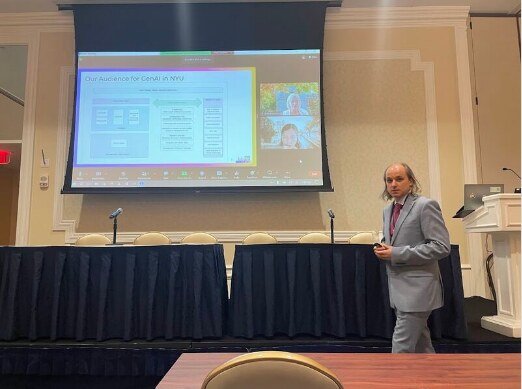
The team is led by Dr. Sergey Samsonau (LinkedIn), an expert in AI, science, and research education, who supervises every team. He works on both sides of this intersection, applying AI to science himself and guiding research teams, and he developed the methodology this program runs on.
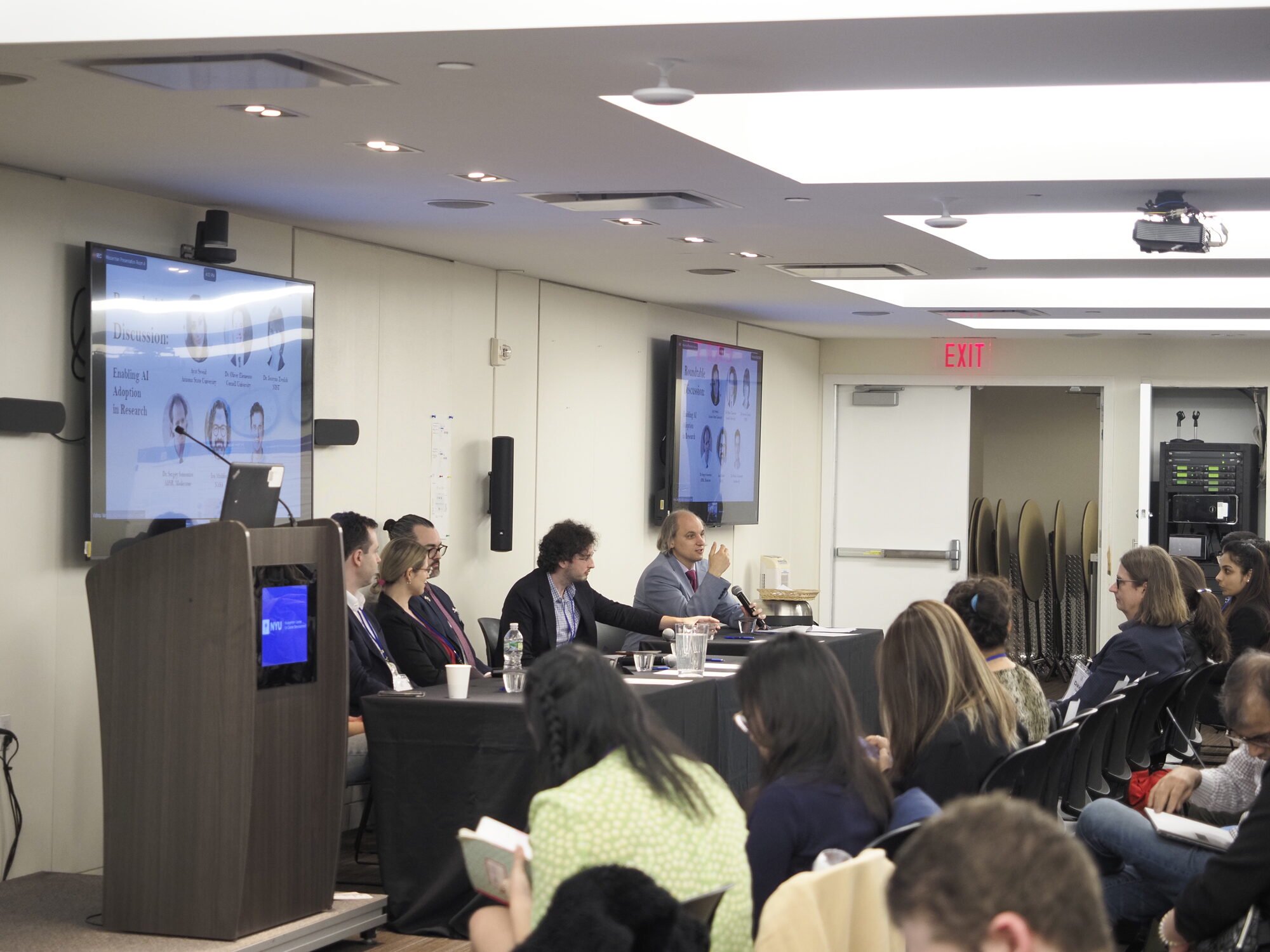
He has spent a decade helping scientists bring modern tools into their work: serving as AI Technical Lead at NYU for five years, and leading research-enabling AI and data science initiatives across disciplines. He organized the AI Meets Science conference, the first of its kind for the NYC metro area, with top voices from NASA, NIST, the Simons Foundation, SandboxAQ, Columbia, Cornell, Princeton, NYU, Rutgers, Fordham, Arizona State, and Stevens Institute of Technology.
On each team he works as a Research Guide, an expert who guides rather than assigns. He co-authored the paper that defines the role, The Research Guide: From Informal Role to Profession (Samsonau & Pearce, arXiv:2604.19961, 2026).
Start Any Time
Enrollment is ongoing. New teams form continuously as Residents are admitted and matched, rather than on a fixed semester calendar.
Because engagements overlap, the Residency may contain teams partway through their work alongside teams just beginning. Newer teams watch experienced teams present; experienced teams answer newer teams' questions.
Who Gets In
The Residency is open to applicants who currently live or study in North America, South America, or Europe (including the UK). As part of admission, we confirm each applicant's identity through a secure third-party verification service.
Admission is by interview. There is no prior-research requirement, no pedigree, and no credential to clear. For some Residents this is their first path to real research; for others it is professional, team-based experience they cannot get in a classroom or a single lab. Residents come from every career stage:
- Undergraduates ready for open-ended research beyond coursework and lab classes.
- Graduate students, including PhD students, who want real-life professional experience: a team, defined roles, and a deliverable for an external partner, beyond a thesis.
- Postdocs and early-career researchers who want professional, team-based experience building and delivering a usable result for a real stakeholder, alongside their academic research.
- Recent graduates between degrees or jobs who want real research experience to build on.
- Career changers moving into research, data, or AI-driven science from another field.
- Working professionals, early to late career: engineers, developers, analysts, and others who want to contribute to scientific research alongside their job.
- Citizen scientists who want more than participatory science: real, end-to-end research, not only contributing observations or data.
What We Look For
Our goal is to form the strongest team we can for each project. That is what guides who we admit, and when.
The expertise the team needs. We admit the way a research group forms: people whose strengths fit together and whose presence makes each member accountable to the rest. Every team needs one or two domain experts in one of the natural sciences, whether your strength is experimental or theoretical. Beyond that, your strength can be any of the areas of responsibility a team divides up, listed under How It Works above, from the methods to the engineering, the interface, or the project management. AI is one part of this, not the whole job, so your background does not have to involve it. You do not need prior research experience, but we look at two things: whether your expertise complements what the team already has, and whether your demonstrated level in your area is strong enough to make a real contribution to the work we deliver for partners. A strong applicant may be placed in a later team because a current one already has the strengths they bring and needs others. That is a team-composition decision, not a judgment of you.
Prior research experience counts in your favor, but it is not required. What carries weight is demonstrated expertise in your area, the drive to investigate a real question, and the willingness to do the work with other people depending on you.
The Commitment
A partner is counting on the team. Every Resident owns a real part of the work that the others depend on. We look for people who finish what they start and will show up for the others.
- Commit to the partner's area of need.How to tackle it is your team's to discover and design with your Research Guide; the area itself is the partner's, not a topic of your own.
- Show up to every session, prepared.
- Do the work between sessions.
- Stay accountable to your team and the cohort.
- Follow through on what you take on, across the full six months.
What Partners Get
As a partner, you bring a research question from your own scientific work, and we put a team on it for six months. The team works independently, under an ARP Research Guide, toward a result you can use. The Residents stay ours, working your problem, not joining your group.
The Residency takes on research, not products. A project fits when it advances your science: a workflow to improve or make reproducible, an analysis or model for a question you are pursuing, or an open-ended "where could AI help in my research, and how?" It does not fit when the goal is a commercial product, something built for sale or for running a business. The team takes your question from there, scopes it, tests what AI can do for it, and builds toward a result you can use. This boundary is what keeps the program educational and public-interest. Intellectual property and the use of results are set in a short written agreement with each partner, strongly guided by the nonprofit, public-interest nature of the program.
The team covers the full stack, from your science to the implementation. They work out which modern methods fit the problem: data science and visualization, classical machine learning, deep learning, and today's generative and agentic AI. They engineer the result into reproducible, usable software. You need no technical background of your own.
Your time commitment is light: at most an hour every two weeks, often less. The team does the work and brings findings back to you.
We work with partners of many kinds: universities and individual faculty, national labs, government science agencies, research-driven organizations, and independent scientists. What matters is a real research question or need, not the size or type of the organization behind it.
Because the program is educational and public-interest, the engagement can count toward the broader-impacts and outreach components that grant proposals ask for, such as NSF Broader Impacts. Ask us for a short paragraph you can include in a proposal.
Want to bring AI into your research? Write to us at hello@arpconnect.com.
Free for every admitted Resident. We will invite you to an interview if we see a strong fit.
Apply nowFor Donors
The Residency is free for every admitted Resident. It is offered through the Authentic Research Access Program, a nonprofit initiative fiscally sponsored by NOPI, a registered 501(c)(3).
Donations sponsor two things at once: authentic research education for people who were never given it, and better science driven by modern technology for the partners whose questions the teams take on. They keep seats open regardless of anyone's ability to pay.
Companies and foundations that want to widen access to real research can fund seats and cohorts as donors. Funding is undesignated: it opens seats for the program to fill on its own terms, with no specific individuals named and no recruiting or hiring access in return. Donors are gladly recognized as supporters; the benefit of the work flows to the Residents and to the field.
Authentic Research Partners is fiscally sponsored by the Nonprofit Organization for Philanthropic Initiatives, a program of NOPI INC, a Massachusetts nonprofit corporation and 501(c)(3) organization, EIN 81-5089505. Learn more at https://thenopi.org.